
- Басты бет
- /
- Зерттеулер
- /
- Bushehr: What the Escalating Threat to Iran's Nuclear Plant Means for Central Asia
Bushehr: What the Escalating Threat to Iran's Nuclear Plant Means for Central Asia
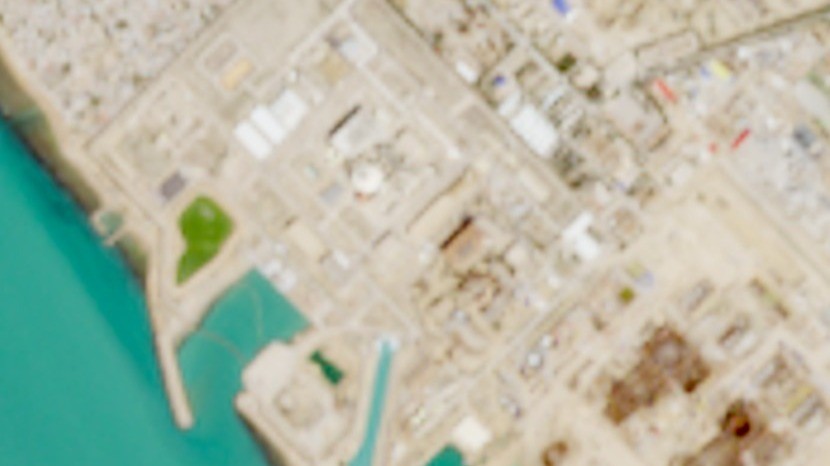


On April 4, 2026, Rosatom evacuated 198 employees from the Bushehr Nuclear Power Plant after a strike on the facility's physical protection perimeter. An auxiliary building was damaged and a security guard was killed, the first casualty reported since the shelling began.
Three weeks earlier, on March 17, a projectile struck 350 meters from an operating reactor. The IAEA confirmed the destruction of a building on site. Director General Rafael Grossi called it the crossing of the "reddest of red lines" for nuclear safety. Rosatom CEO Alexey Likhachev confirmed that the blast wave shattered windows across the compound, where 480 personnel remained.
Construction of Units 2 and 3 has been suspended. Since March 10, Rosatom has had no contact with the leadership of Iran's nuclear sector.
This piece uses open-source tools to check what the situation around Bushehr means for Central Asia.
What Is Inside the Reactor
Bushehr-1 is a VVER-1000/V-446 reactor with an electrical output of 915 MW, connected to Iran's grid in 2011. Russia supplied 82 tons of initial fuel. Spent fuel is stored on site. The core contains Cesium-137, Strontium-90, Iodine-131 and other fission products.
A power reactor holds orders of magnitude more radioactive material than a nuclear weapon. Chernobyl released hundreds of times more radioactive substances than the Hiroshima bomb. The VVER containment is much stronger than the Chernobyl-type RBMK design. The problem is that it was engineered to withstand accidents, not a direct military strike.
Andrey Ozharovsky, a nuclear physicist with the Radioactive Waste Safety program, gave concrete numbers in interviews this spring (Novaya Gazeta, 8 April 2026; Argumenty i Fakty, 3 March 2026). Rosatom containment shells are rated for the impact of a small aircraft up to 5.7 tons. They are not rated for shells above 150 mm or cruise missiles. By his assessment, an accident at a shutdown reactor would limit dispersion to a few kilometers. At an operating reactor, the radius reaches hundreds or thousands of kilometers.
The spent fuel pool may be more dangerous than the reactor itself. If cooling is disrupted, fuel assemblies overheat and degrade, releasing long-lived radionuclides.
Iranian scientists have modeled accident scenarios at Bushehr with the HYSPLIT atmospheric transport model (Kaviani et al., 2017, 2021; Pirouzmand et al., 2018; Feyzinejad et al., 2018, 2019). Most of these studies were limited to a radius of 30-80 km. Only one, Kaviani et al. (2021), modeled long-range transport, and it found the highest deposition outside Iran over Turkmenistan. None of them assessed what a release would mean for the Caspian littoral or for Mangistau's water supply.
Seismicity
Military strikes are only part of the risk. In 2019, Kazakh and Russian seismologists Yu.F. Kopnichev and I.N. Sokolova (Institute of Geophysical Research, Kurchatov; IPE RAS) published a paper in the Bulletin of the National Nuclear Center of Kazakhstan on ring-shaped seismicity structures in the Iran region. Their conclusion: a ring structure is forming in southwestern Iran, which indicates a developing earthquake of Mw=7.2±0.3. The intersection zone of the shallow and deep seismicity rings lies roughly 60 km from the Bushehr plant.
One clarification. This is a peer-reviewed paper by Kazakh scientists, published years before the current conflict. I cite it as a data point. Predicting an imminent quake is a different claim, and the paper does not make it. What the authors do say is that a strong event in southwestern Iran may pose a special danger precisely because its source would be close to the Bushehr plant.
Russian engineering geologists (Makeev, Guseltsev, Kravchenko, 2020) found that the plant site is crossed by weakened zones linked to buried faults. The foundation of Reactor Building No. 1 has shown uneven settlement and tilting since construction began in 1976. These zones were not identified during the original site survey. A strong earthquake on top of military strikes is a combination that no standard safety model covers.
Where the Wind Blows
HYSPLIT (Hybrid Single-Particle Lagrangian Integrated Trajectory) is an atmospheric transport model developed by NOAA. It is free and runs in a browser (ready.noaa.gov). Analysts used it to track radionuclides across the Atlantic after Fukushima and to trace the source of Ruthenium-106 detected across Europe in 2017.
Bushehr sits at 28.83°N, 50.89°E. The distance to Aktau is approximately 1,650 km, mostly across the Caspian. For comparison: Chernobyl to Sweden is around 1,200 km, and contamination was detected there two days after the disaster.
Winds around Bushehr change with the season. In spring and summer the northwesterly shamal dominates. At altitudes of 2,000-5,000 m, which is where a radioactive plume would travel, the pattern differs. Modeling shows that within the first hour of an accident, material disperses across a 25 km radius at altitudes of 450-2,700 m (Kaviani et al., 2021). For transport across the Caspian to the Mangistau coast, the modeled window is 48-96 hours.
Anyone can check this independently. Open NOAA HYSPLIT READY, select Forward Trajectories, enter the Bushehr coordinates, take GDAS meteorological data, set altitudes at 500, 1,500 and 3,000 m, and run a 96-hour simulation.
Vulnerability Map
Mangistau Region, Kazakhstan. Aktau has a population of over 200,000 and sits approximately 1,650 km from Bushehr, across the Caspian.
Mangistau depends entirely on desalination. The Astrakhan-Mangyshlak pipeline and the desalination plants together provide around 164,000 m³ per day. The summer deficit already reaches 50,000 m³ per day. Nine new desalination plants worth 247 billion tenge (about $540 million) are under construction. All of them draw water from the Caspian.
Even low-level contamination of the Caspian would force water intakes to shut. The reason is mundane. Reverse osmosis systems and drinking water standards have permissible limits, and those limits would be breached long before a dangerous dose accumulates. If desalination stops, Mangistau has a water crisis within days.
Aktau also has its own nuclear legacy. The BN-350 fast breeder reactor operated here from 1973 to 1999, and the MAEK site still holds about 2,700 m³ of liquid radioactive waste, by the operator's own figures. A domestic legacy plus an external threat is a combination the region has not faced before.
Balkan Province, Turkmenistan. The port of Turkmenbashi lies roughly 1,250 km from Bushehr. Oil and gas operations concentrate in Khazar (Cheleken). Turkmenistan has no publicly accessible environmental monitoring, no independent environmental agencies, and no published data on nuclear incident preparedness. It is the most closed country in the region and the closest to the potential contamination zone.
The Caspian ecosystem. Five states share the Caspian. It supports sturgeon, the endemic Caspian seal and commercial fisheries. Contamination would put seafood exports in question. Farmland in southern Turkmenistan and western Kazakhstan depends on rainfall, and rain quality changes if a radioactive plume passes over the region.
Precedents
Chernobyl, 1986. The RBMK-1000 had no containment and differs fundamentally from the VVER. The relevant part is the scale of atmospheric transport: contamination reached Sweden, about 1,200 km away, within two days. Bushehr to Aktau is about 1,650 km.
Fukushima, 2011. HYSPLIT tracked transpacific transport to North America. The lesson for Bushehr is water as a contamination pathway. The plant sits on the coast, and fallout over the Caspian goes directly into the water.
Iraq, 1991. The oil fires were a different type of event, but they show the reach of atmospheric transport. Smoke plumes were detected in Central and South Asia. What happens in the Persian Gulf does reach Central Asia.
What No One Is Measuring
Persian Gulf states run radiation monitoring and worry openly about their desalination plants. Central Asia does neither.
Kazakhstan has its own nuclear legacy, Semipalatinsk and BN-350, but its monitoring looks inward, at domestic sites. The region has no equivalent of Europe's EURDEP system. Sentinel satellite data and NASA FIRMS are public, but no regional body interprets them for a Bushehr scenario.
There is also no external backstop left. As Ozharovsky notes, the IAEA is not a disaster response organization. Its cooperation with Iran has effectively stopped and the inspectors have been expelled. In a radiation emergency, Iran and its neighbors would be on their own. For Central Asia that means no external oversight and no early warning.
One open question: has any Central Asian government run a HYSPLIT model for this scenario? I could not find evidence that anyone has.
What This Means for Business
For investors and operators in Mangistau, water supply is the critical risk. Desalination plants draw directly from the Caspian and have no documented protocols for radioactive contamination. Modern reverse osmosis systems can filter some radionuclides, but current plant designs include no specific protection against a transboundary nuclear incident. Force majeure clauses covering nuclear events are most likely absent from existing contracts. I found no public record of such clauses.
For logistics: the Trans-Caspian corridor runs through the Caspian via the ports of Aktau and Kuryk. Bushehr is approximately 1,650 km away. Prevailing currents in the Caspian flow northward, so waterborne contamination would take months to reach Mangistau shipping lanes. Atmospheric fallout works on a different timeline: 48-96 hours. Cargo insurance and crew safety protocols for a radiological scenario do not exist, as far as I can establish.
For governments: the Tehran Convention's new EIA Protocol, in force since 18 November 2025, requires a transboundary environmental impact assessment for listed projects if a Caspian littoral state requests one. There is no dedicated protocol for nuclear accidents or radiation emergencies, only the general obligation to cooperate on pollution response. The Aktau Protocol (2011) covers oil spills, not radiation. That gap is still open.
A Model Anyone Can Run
The tools to assess this risk are free. HYSPLIT runs in a browser, Sentinel data is open. The real question for Central Asian governments and businesses is simpler: is anyone looking at the data at all?
Sources & References
Kaviani, F., Memarian, M.H., Eslami-Kalantari, M. - Simulation of Atmospheric Dispersion, Transport and Deposition of Nuclear Pollutants Released from a Hypothetical Accident at Bushehr Power Plant, Journal of Earth and Space Physics, Vol. 43, No. 3, 2017.
Kaviani, F., et al. - Radioactive Impact on Iran and the World from a Postulated Accident at Bushehr Nuclear Power Plant, Progress in Nuclear Energy, 2021.
Pirouzmand, A., Kowsar, Z., Dehghani, P. - Atmospheric Dispersion Assessment of Radioactive Materials during Severe Accident Conditions for Bushehr Nuclear Power Plant Using HYSPLIT Code, Progress in Nuclear Energy, Vol. 108, 2018.
Feyzinejad, M., et al. - Simulation of Atmospheric Dispersion and Dose Assessment by a Coupled WRF-HYSPLIT Model for Bushehr Power Plant, Iranian Journal of Geophysics, Vol. 12, 2018.
Feyzinejad, M., Malakooti, H., Sadrinasab, M., Ghader, S. - Radiological Dose Assessment by Means of a Coupled WRF-HYSPLIT Model under Normal Operation of Bushehr Nuclear Power Plant, Pollution, Vol. 5, No. 2, 2019.
Kopnichev, Yu.F., Sokolova, I.N. - Ring-Shaped Seismicity Structures in the Region of Iran: Possible Preparation for Large Earthquakes, Bulletin of the National Nuclear Center of the Republic of Kazakhstan (Vestnik NNC RK), Issue 2, 2019, pp. 106-113. (In Russ.)
Makeev, V.M., Guseltsev, A.S., Kravchenko, I.M. - Identification of Weakened Zones in Engineering-Geological Investigations: The Case of the Bushehr NPP Site, Geoekologiya. Inzhenernaya geologiya, gidrogeologiya, geokriologiya, No. 5, 2020. (In Russ.)
Ozharovsky, A. - interview to Novaya Gazeta, "Atomnoe pugalo" (On the Danger of the Shelling of Bushehr NPP), 8 April 2026.
Ozharovsky, A. - interview to Argumenty i Fakty, "What a Strike on Iran's NPP Threatens", 3 March 2026.
TASS - Rosatom Staff Evacuated from Bushehr NPP to Leave Iran within 2-3 Days, 4 April 2026.
Turkiye Today - Russia Pulls 163 More Workers from Iran's Bushehr, 25 March 2026.
World Nuclear News - IAEA Confirms Projectile Strike near Bushehr Reactor, 18 March 2026.
Bizmedia.kz - Nine Desalination Plants to Be Built in Mangistau Region for 247 Billion Tenge, 27 April 2023.
Zakon.kz - Ten Drinking Water Projects Underway in Mangistau Region, 20 December 2024.
MAEK-Kazatomprom - BN-350: The World's First Fast Neutron Reactor (liquid radioactive waste figures), maek.kz, 2020.
Atomic-energy.ru - On the Decommissioning of the BN-350 Fast Reactor in Aktau, 29 July 2022.
Framework Convention for the Protection of the Marine Environment of the Caspian Sea (Tehran Convention) - Protocol on Environmental Impact Assessment in a Transboundary Context, in force since 18 November 2025.
Protocol Concerning Regional Preparedness, Response and Co-operation in Combating Oil Pollution Incidents (Aktau Protocol), 2011.
IAEA - Environmental Consequences of the Chernobyl Accident and Their Remediation: Twenty Years of Experience, Vienna, 2006.
NOAA Air Resources Laboratory - HYSPLIT Atmospheric Transport and Dispersion Model, ready.noaa.gov.
Copernicus - Sentinel satellite data, Copernicus Open Access Hub.
NASA - Fire Information for Resource Management System (FIRMS).
European Commission, Joint Research Centre - EURDEP (European Radiological Data Exchange Platform).
Latest Insights
Барлық жарияланымдар